HERO is a national, multi-site, 3-year collaboration launched in 2025, led by Principal Investigators Dr. Abigail Ford Winkel (New York University) and Dr. Helen Morgan (University of Michigan). The initiative brings together diverse health systems to better understand the factors shaping the OBGYN workforce across a range of clinical and organizational settings.
Through structured data collection and cross-site analysis, HERO examines how patient needs, practice environments, and clinician experiences influence well-being, engagement, retention, and care delivery. By integrating perspectives from physicians and their teams, the project aims to identify practical, system-level strategies that support a thriving, sustainable, and equitable workforce and ultimately improve access to high-quality care nationwide.
Advancing System-Level Solutions to Support Workforce Well-Being and Patient Safety
The Problem
Across the country, obstetrics and gynecology is facing unprecedented strain:
Geographic and legal barriers limit access to reproductive health care.
High levels of burnout and attrition threaten the workforce.
Workplace inequities affect who enters, stays, and advances within the field.
Patients experience persistent disparities in care access, experience, and outcomes, often shaped by race, ethnicity, socioeconomic status, and geography.
The HERO Approach
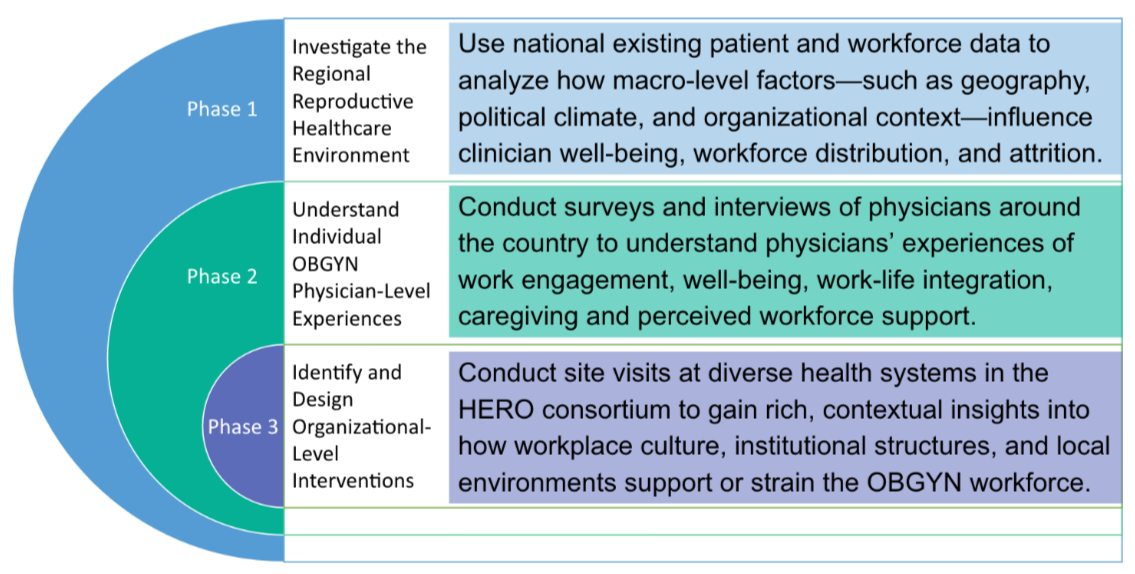
The HERO Project uses a three-phase research approach to understand how workforce conditions shape clinician well-being, career sustainability, and access to reproductive healthcare.
Phase 1: National Landscape Analysis
We analyze national datasets and policy environments to identify broad patterns in workforce trends, regional variation, and structural factors influencing the OBGYN workforce.
Phase 2: Individual Experience and Perspectives
Through collaboration with the Intern Health Study, we examine how physicians experience their work using targeted surveys and interviews with practicing OBGYNs. This phase focuses on well-being, engagement, career decision-making, and the day-to-day realities of clinical practice across diverse settings.
Phase 3: Consortium Engagement and Synthesis
Working with a national network of academic and community partners, we conduct structured site-level data collection and learning exchanges to understand how organizational context shapes workforce outcomes.
Together, these phases provide a comprehensive view to inform approaches that support a resilient, engaged, and equitable OBGYN workforce. We then integrate findings across phases to identify key drivers and develop practical, system-level strategies that can be adapted across settings.